
Claim Refund After Deceased Taxpayer Form Instructions
This document provides detailed instructions for claiming a tax refund due to a deceased taxpayer. It guides users through the process of completing Form 1310 effectively. Ensure compliance with IRS requirements by following this comprehensive guide.
Edit, Download, and Sign the Claim Refund After Deceased Taxpayer Form Instructions
Form
eSign
Add Annotation
Share Form
How do I fill this out?
To fill out Form 1310, start by gathering necessary information about the decedent and the person claiming the refund. Carefully check which category you fall under in Part I and provide accurate details in Part II. Finally, ensure that you sign and verify the information in Part III for submission.

How to fill out the Claim Refund After Deceased Taxpayer Form Instructions?
1
Gather necessary information about the decedent.
2
Select the appropriate category in Part I.
3
Complete details in Part II if applicable.
4
Sign and verify the information in Part III.
5
Submit the completed Form 1310 to the IRS.
Who needs the Claim Refund After Deceased Taxpayer Form Instructions?
1
Surviving spouses who are seeking to reclaim refunds.
2
Personal representatives of an estate who must file for refunds.
3
Family members managing the affairs of a deceased relative.
4
Tax professionals filing on behalf of clients who are deceased.
5
Heirs of the decedent needing access to tax refunds.
How PrintFriendly Works
At PrintFriendly.com, you can edit, sign, share, and download the Claim Refund After Deceased Taxpayer Form Instructions along with hundreds of thousands of other documents. Our platform helps you seamlessly edit PDFs and other documents online. You can edit our large library of pre-existing files and upload your own documents. Managing PDFs has never been easier.

Edit your Claim Refund After Deceased Taxpayer Form Instructions online.
Editing this PDF on PrintFriendly is an efficient way to customize your form. Simply upload the document and navigate through the fields to input your information. Use our tools to modify text, ensuring that everything is accurate before you print or download.

Add your legally-binding signature.
Signing the PDF on PrintFriendly is easy and secure. You can add your signature directly to the document using our intuitive interface. Once you’re satisfied with your signature placement, simply save or download the file.
Share your form instantly.
Sharing your edited PDF on PrintFriendly is convenient and straightforward. Once your document is ready, you can generate a shareable link for others to access. Easily distribute your PDF via email or social media platforms.
How do I edit the Claim Refund After Deceased Taxpayer Form Instructions online?
Editing this PDF on PrintFriendly is an efficient way to customize your form. Simply upload the document and navigate through the fields to input your information. Use our tools to modify text, ensuring that everything is accurate before you print or download.
1
Upload the PDF document to PrintFriendly.
2
Navigate to the specific fields you wish to edit.
3
Enter your required information accurately.
4
Review all changes to ensure correctness.
5
Download or print the edited document.

What are the instructions for submitting this form?
To submit Form 1310, mail it to the appropriate address specified by the IRS based on the state you reside in. Ensure you include any required documentation such as certificates of appointment or wills if applicable. Follow all provided instructions to guarantee timely processing of the refund claim.
What are the important dates for this form in 2024 and 2025?
For the tax years 2024 and 2025, ensure that Form 1310 is submitted by the filing deadlines, typically April 15 of the following year. Stay updated for any changes to deadlines and filing requirements on the IRS website.

What is the purpose of this form?
The primary purpose of Form 1310 is to allow individuals to claim tax refunds that are due to a deceased taxpayer. This form is critical for ensuring that surviving relatives or estate representatives can access any owed refunds. By providing clear guidelines for filling out this form, The IRS aims to simplify the process for those handling the affairs of deceased taxpayers.

Tell me about this form and its components and fields line-by-line.

- 1. Name of Decedent: Full name of the deceased individual who is owed a tax refund.
- 2. Date of Death: The date when the decedent passed away, which is essential for processing the claim.
- 3. Claimant's Name: The full name of the individual requesting the refund on behalf of the decedent.
- 4. Claimant's Social Security Number: Social security number of the person claiming the refund.
- 5. Decedent's Social Security Number: Social security number of the deceased taxpayer.
- 6. Part I Selection: Checkbox to indicate the category under which the claimant is filing.
- 7. Part II Questions: Questions related to the decedent’s estate and whether a will exists.
- 8. Signature: Signature of the person claiming the refund, confirming the accuracy of the claim.
What happens if I fail to submit this form?
Failure to submit Form 1310 may result in the delay of a refund that is rightfully owed to the decedent's estate. The IRS requires this form to process refunds due to deceased individuals accurately.
- Delayed Refund: Without proper submission, refunds may be held until verification is complete.
- Increased Scrutiny: Error in submission might trigger additional verification requests from the IRS.
- Legal Complications: Failure to complete can lead to issues within legal proceedings regarding the estate.
How do I know when to use this form?

- 1. Claiming Refunds for Deceased Taxpayers: Utilize this form when seeking tax refunds after the death of a taxpayer.
- 2. Executing Estate Tax Matters: This form may be needed to handle financial matters related to the decedent's estate.
- 3. Filing on Behalf of Another: If you are filing a tax refund claim for someone who has passed, this form is necessary.
Frequently Asked Questions
What information do I need to fill out Form 1310?
You'll need details about the deceased, the person claiming the refund, and any relevant accounts or tax information.
Can I edit this form before downloading?
Yes, PrintFriendly allows you to edit the form before you download the final version.
Is it necessary to sign the form?
Yes, you must sign the form in Part III to validate your claim for the refund.
What should I do if I need assistance with the form?
You can consult a tax professional or refer to the IRS website for guidance.
Can I share the edited PDF with others?
Absolutely, you can generate a shareable link after editing your document.
How can I ensure my refund is processed?
Ensure all details are correctly filled and signatures are added before submission.
Do I need any documentation to submit along with Form 1310?
Yes, attachments like a court certificate may be required depending on your situation.
What if I'm claiming the refund for an estate?
You’ll need to complete Part II of the form for claims related to a decedent's estate.
Is there a deadline for submitting this form?
Yes, it should be submitted alongside the relevant tax return or by the federal tax deadline.
Can I edit the PDF on my mobile device?
Yes, you can edit the PDF using PrintFriendly on any device with internet access.
Related Documents - Form 1310 Instructions
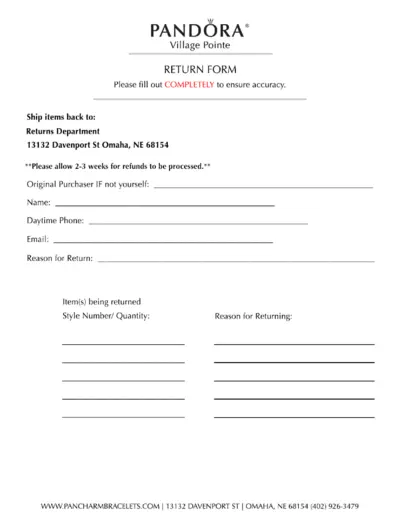
PANDORA Village Pointe Return Form Instructions
This file provides the return form for PANDORA Village Pointe. It includes sections to fill out the original purchaser information, return reason, and item details. Ensure all fields are completed accurately before sending.
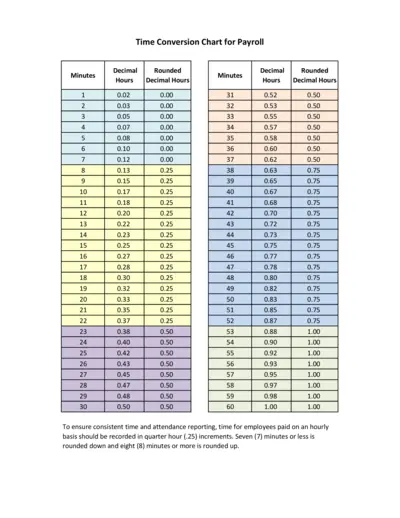
Time Conversion Chart for Payroll
This file provides a time conversion chart for payroll, converting minutes into decimal hours. It aids in accurate and consistent time reporting. Ideal for employees paid on an hourly basis.
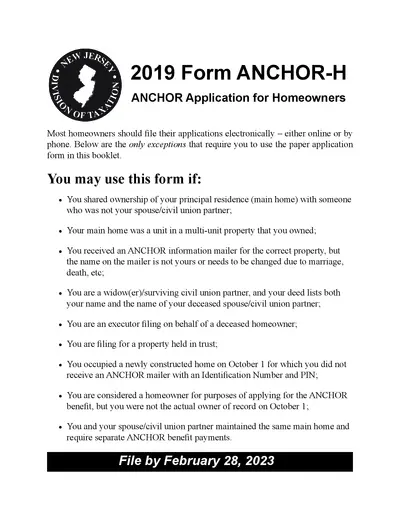
2019 ANCHOR Application for Homeowners - New Jersey
The 2019 ANCHOR Application for Homeowners provides eligibility details and instructions for applying for the New Jersey ANCHOR benefit. Learn how to file, eligibility requirements, and submission guidelines. This document ensures proper benefit distribution for eligible homeowners.
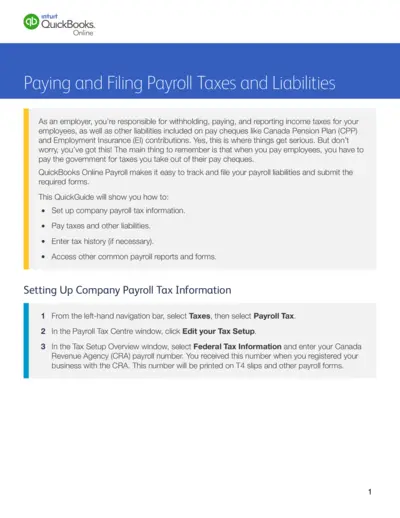
QuickBooks Online Payroll Taxes and Liabilities Guide
This file provides comprehensive instructions on how to set up, pay, and file payroll taxes and liabilities using QuickBooks Online. Employers can track and report income taxes, CPP, and EI contributions. The guide also covers entering tax history and accessing various payroll forms and reports.
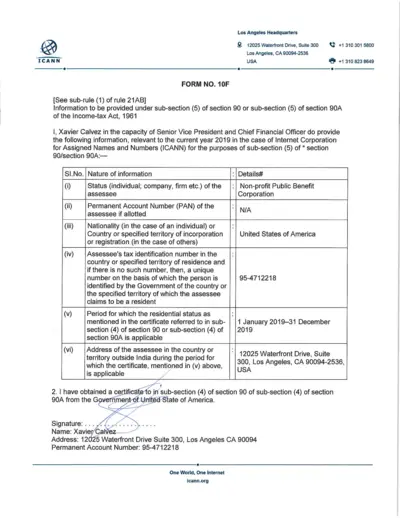
ICANN Income Tax Form 2019 for Tax Compliance
This file contains the information required under sub-section (5) of section 90 or 90A of the Income-tax Act, 1961 for ICANN. It includes details about tax identification, residential status, and a verification declaration for the year 2019. The information is provided by Xavier Calvez, the Senior Vice President and Chief Financial Officer at ICANN.
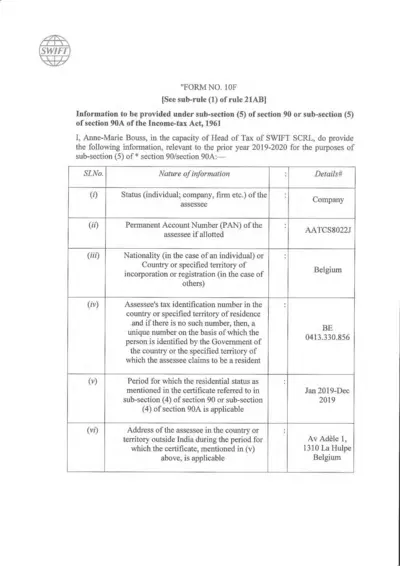
Form 10F: Information under Section 90/90A of Income-tax Act
Form 10F is used to provide information under sub-section (5) of section 90 or 90A of the Income-tax Act, 1961. It is relevant for the prior year 2019-2020 for SWIFT SCRL in Belgium. This form includes details about the assessee's status, account numbers, residency period, and address.
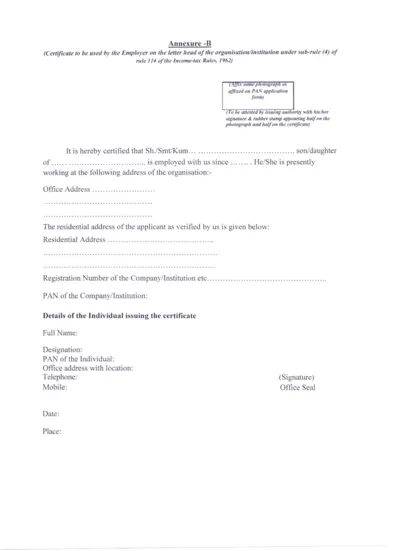
Employer Certificate for PAN Application - Income-tax Rules
This certificate is used by the employer to certify the employment status of an individual for PAN application under Income-tax Rules, 1962. It includes organization details, employee verification, and needs to be attested.
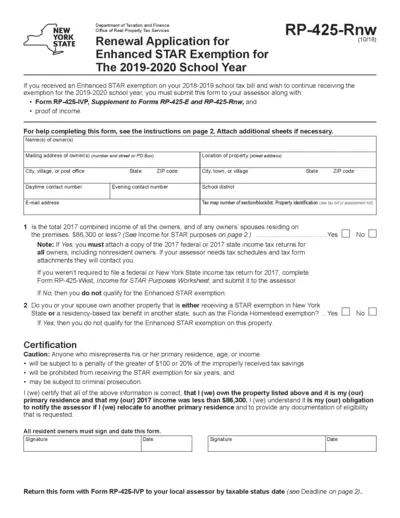
Renewal Application for Enhanced STAR Exemption 2019-2020
The form is used to reapply for the Enhanced STAR exemption on school taxes for the 2019-2020 school year. It requires income proof and the completion of Form RP-425-IVP. Submission is necessary to the local assessor by the taxable status date.
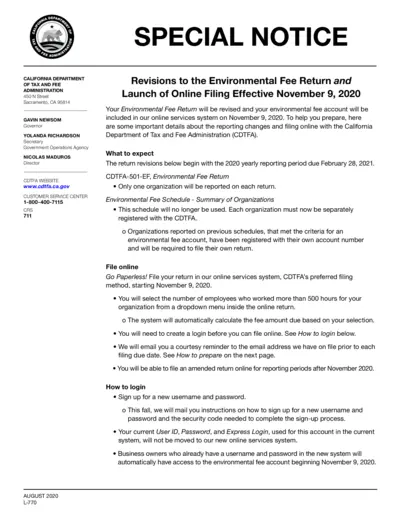
Revisions to Environmental Fee Return & Online Filing
This file details the revisions to the environmental fee return and the launch of online filing effective November 9, 2020. It includes important information on what to expect, how to login, and how to prepare for filing. The instructions provided are essential for organizations required to file the Environmental Fee Return.
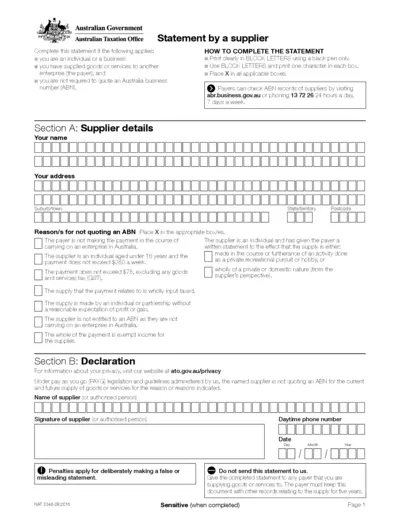
Statement by a Supplier - Australian Taxation Office Form
This form is used by individuals or businesses supplying goods or services without quoting an Australian Business Number (ABN). It helps in providing reasons for not quoting an ABN. The payer must keep this completed form for their records for five years.
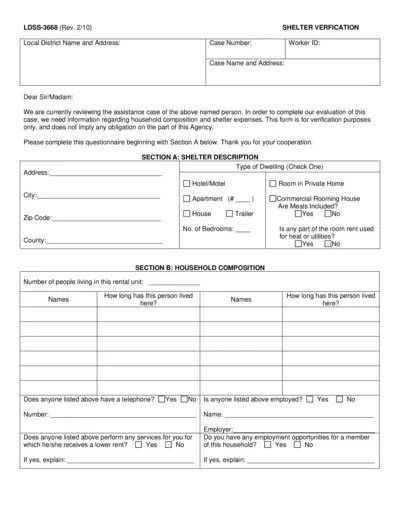
Shelter Verification Form for Assistance Evaluation
This form is used to verify household composition and shelter expenses for assistance evaluation purposes. It includes sections for shelter description, household composition, and shelter expenses. Complete the questionnaire for accurate verification.
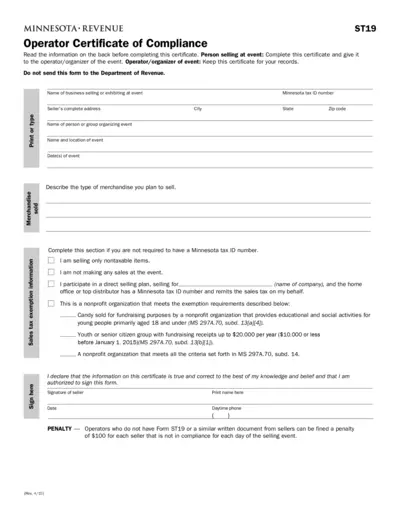
Minnesota ST19 Operator Certificate of Compliance
The Minnesota ST19 Operator Certificate of Compliance is required by law for sellers and event operators to certify compliance with sales tax regulations. The form must be completed by the seller and provided to the operator of the event. Penalties apply for non-compliance.